Showing posts with label to can. Show all posts

9 Jun 2020

Talk about yourself (speaking)

Do you remember the «Talk about yourself» worksheet we did last week? Today is time to do the same but speaking. Kevin helps us!


We will also do it in nine parts or phrases:
1. Say «Hello». Hello...
2. What’s your name? My name is...
3. How old are you? I’m... 
4. What month is your birthday? My birthday is in...
5. What have you got? What you haven’t got? I’ve got... / I haven’t got...
6. What can you do? What can't you do? I can... / I can’t...
7. What are you wearing? I’m wearing...
8. What is your favourite animal? My favourite animal is...
9. What do you like for breakfast, lunch and dinner? I like... 
Let's go! It's your turn! Practice first (last week's worksheet will help you). Prepare everything you need, record your phrases on video and send it to me.
Resumen tareas: «Talk about yourself (speaking)» (10-6-20)
—Siguiendo el modelo de la ficha «Talk about yourself» de la semana pasada, hoy toca hacer la misma actividad pero oral.
—Ver y escuchar atentamente el vídeo de Kevin. Lo usaremos como ejemplo.
—Repasar las nueve frases que se deben decir (esquema arriba). Valen las de la ficha de la semana pasada, u otras.
—Preparar algunas cosas (si se quiere) para «escenificar» las frases: ropa, juguetes, comida...
—Grabar el vídeo con las frases (si algún niño/a prefiere grabar sólo audio, también vale).
—Por último, enviar los archivos a
fogarnews@gmail.com a través de wetransfer.com. Damos hasta el sábado 13 para hacerlo. Animo!

2 Jun 2020

Talk about yourself (writing)


We are already approaching the end of the academic year. We are going to review a little bit today the most important things of this course. Look at the top picture. That girl, Mary, talk us about herself. You, like her, must use nine sentences:
1. A greeting.
2. Your name.
3. Your age.
4. The month of your birthday.
5. What you have and what you don't have.
6. What you can do and what you cannot do.
7. What you are wearing.
8. Your favorite animal.
9. What you like for breakfast, lunch and dinner.
Here you have a PDF worksheet so you can write those sentences and make your own drawing. Remember everything we studied this year and follow the example of Mary's sentences. This will be easier. You can color your picture if you feel like it. 

If you can't print the PDF worksheet, you can also do it all on a separate sheet.

Please, at the end, send me your worksheets to fogarnews@gmail.com.

Resumen tareas: «Talk about your self (writing)» (26-5-20)
—Como repaso final, haremos la ficha «Talk about your self» (Habla de ti mismo/a).
—Ver y leer el modelo que se presenta. Consta de dibujo y nueve frases:
1. Saludo («Hello!», o otros)
2. Tu nombre
3. Tu edad
4. El mes de tu cumpleaños
5. Lo que tienes y no tienes
6. Lo que puedes hacer y lo que no
7. Lo que llevas puesto
8. Tu animal favorito
9. Lo que te gusta comer para el desayuno, comida y cena

—Aquí tenéis una ficha en PDF para poder hacer la actividad por escrito. Si hay problemas para imprimirla, se puede hacer en una hoja aparte (o en el texto del correo electrónico). Si apetece, se puede hacer también el dibujo y colorearlo.
—Cuando esté lista la ficha, por favor, enviadla a
fogarnews@gmail.com.

4 May 2020

Musical instruments


Here we are again. Today we have to practice the names of musical instruments. Remember, we studied them in Unit 3.

Pay attention to the image and also to this video. Some of the instruments you already know and others are new.


And now, click here and here and do the proposed activities.

See you soon!
Resumen tareas: «Musical instruments» (5-5-20)
—Observar con atención la ilustración y el vídeo. Contienen algunos instrumentos musicales y otros que resultarán nuevos.
—Realizar estas actividades interactivas sobre el vocabulario de los instrumentos musicales: aquí y aquí.
—Enviar, fotos o capturas de pantalla de los resultados a fogarnews@gmail.com.

30 Mar 2020

Describing animals

Hello! Remember you already know:
• The names of the animal body parts: legs, wings, scales, feathers...
• The verb to have got (tener)
• The verb to can (poder)
Today we can practice describing animals. You can do it with interactive activities: clic here and here.

Then you are ready to describe animals. Pay attention to this example.

This is a flamingo. It has got pink feathers. It has got long legs, wings, a small head and a long neck. It can fly and swim. It can’t climb.
Finally, open your Activity Book. Draw and describe your favorite animal (Activity 2, page 52). Follow the model of the lion.


26 Mar 2017

Yes, I can


You will like this song. Sure! «Yes, I Can!» is a «Super simple» animal song that introduces a bunch of fun animals (bird, elephant, fish, gorilla...), action verbs (clap, fly, stomp, swim, climb, run...), and the phrases, Can you...? and Yes, I can. / No I can't. 

Here you have the lyrics of the song and, if you want to dance it, you can learn the choreography in this link. Let’s sing and dance!
♫ Little bird, little bird, can you clap?
No, I can't. No, I can't. I can't clap.
Little bird, little bird, can you fly?
Yes, I can. Yes, I can. I can fly.
Elephant, elephant, can you fly?
No, I can't. No, I can't. I can't fly.
Elephant, elephant, can you stomp?
Yes, I can. Yes, I can. I can stomp.
Little fish, little fish, can you stomp?
No, I can't. No, I can't. I can't stomp.
Little fish, little fish, can you swim?
Yes, I can. Yes, I can. I can swim.
Gorilla, gorilla, can you swim?
No, I can't. No, I can't. I can't swim.
Gorilla, gorilla, can you climb?
Yes, I can. Yes, I can. I can climb.
Buffalo, buffalo, can you climb?
No, I can't. No, I can't. I can't climb.
Buffalo, buffalo, can you run?
Yes, I can. Yes, I can. I can run.
Boys and girls, boys and girls, can you sing?
Yes, we can. Yes, we can. We can sing.
Boys and girls, boys and girls, can you dance?
Yes, we can. Yes, we can. We can dance.
We can sing. We can dance. Yes, we can.
Yes, we can. Yes, we can. Yes, we can.
♫

2 Dec 2014

Can and can't


Would you like to practice «can and can't»? Click here and read a brief story about the things that a child can and can’t do.

And here you have «What can you do?», a fun animation that teaches us «can and can't» and «action verbs».

9 Nov 2014

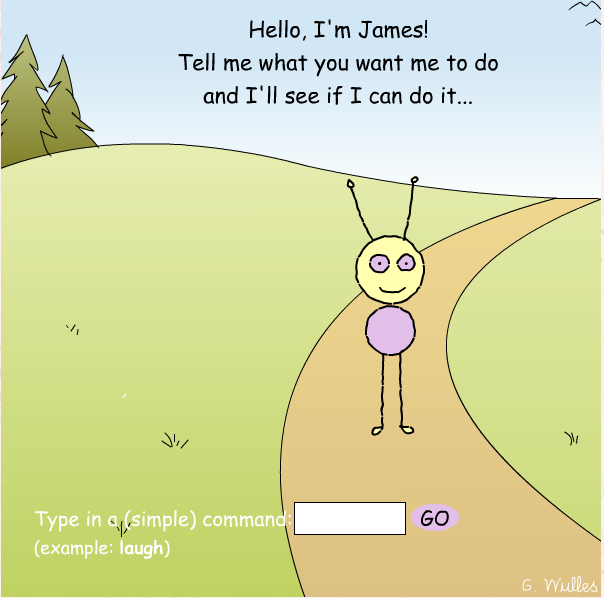
What can James do?

Hello! This is our new friend James. What do you think? Can James dance? Can James sing? Can James climb? Can James fly?... Click the picture and play: write a verb and you’ll see if he can do it or not.

http://enjoyenglish.free.fr/english/college/imperatif/niv2/index.html